

Quick answer: Rail project management software is the set of tools a rail organization uses to plan, resource, cost and govern infrastructure work such as track renewals, electrification, resignalling, stations and new lines. Most rail programs already own a detailed scheduler and a document system. What they usually lack is a portfolio layer that shows people, money, risk and interfaces across every project at once, and that is where most delays become expensive.
This guide is for PMO directors, project controls leads and program directors who are choosing that layer. It explains the rail software stack, six rail-specific tests to run in any demo, and where a portfolio tool like Celoxis fits next to Primavera P6 and the tools you already use.
To write it, I researched the public delivery record of major rail programs in the US, UK, Germany, France, Japan and Saudi Arabia, and I compared the six tools rail teams shortlist most often, including Celoxis, which I used hands-on for this review.
What rail project management software is, and what it is not
Search for “rail scheduling software” and half the results are about timetables. That is a different problem. Timetabling, crew rostering and asset maintenance systems keep the railway running. Rail project management software helps you change the railway: build it, renew it, upgrade it.
- In scope: capital projects and programs such as new lines and metro systems, electrification, resignalling, station redevelopment, track renewals, bridges and tunnels.
- Out of scope: train timetabling, crew rostering, enterprise asset management, signalling design and BIM modeling. These are separate categories with their own specialist tools.
Three groups buy it. Contractors (EPC, civils, track and systems) need to run several packages with shared crews. Consultants (PMC and owner’s engineer roles) need to report on work they do not directly control. Owners, such as transit agencies, infrastructure managers and national railways, need a portfolio view across contractors and funding cycles, which is why many of them start by looking at government project management software. Owners and consultants on public programs often call this layer a PMIS, or project management information system.
Why rail projects run late and over budget
Rail has a long and public record of delay, and the causes repeat across countries.
Oxford professor Bent Flyvbjerg and colleagues studied 258 transport projects across 20 nations and five continents. For the 58 rail projects in that sample, the average cost overrun was 44.7% in constant prices, higher than for roads, bridges or tunnels. Recent flagship programs show the same pattern in every major market:
| Project | Country | What happened | Drivers named in official or company reviews |
|---|---|---|---|
| Crossrail (Elizabeth line) | UK | Due to open in December 2018 at about GBP 14.9bn; opened in May 2022 with a funding package of about GBP 19bn | The National Audit Office found that design changes to construction and systems installation, and changes to contractors’ schedules, cost around GBP 2.5bn between 2013 and 2018 |
| California High-Speed Rail | USA | Voters approved a USD 33bn system in 2008 with a 2020 finish; the 2026 draft business plan puts the full system at up to USD 231bn, with the first Central Valley segment not open before 2032 | Repeated scope and cost changes, and funding gaps |
| Stuttgart 21 | Germany | Early estimates of about EUR 3bn; Deutsche Bahn now forecasts EUR 14.5bn, with opening split into five stages from December 2027 to December 2033 | A DB internal audit found serious failures in planning and project control; DB also cited complex digital signalling, immature planning and a power supply redesign |
| Grand Paris Express | France | Government cost target of EUR 22.6bn; the Cour des comptes reported about EUR 35bn by end of 2017, or EUR 38.5bn including related contributions | Risk and contingency provisions underestimated by close to EUR 7bn, plus weak governance and cost transparency |
| Chuo Shinkansen maglev | Japan | Tokyo to Nagoya opening planned for 2027; JR Central now says 2034 at the earliest | Construction of a roughly 9 km tunnel section could not start because the Shizuoka prefecture withheld approval over water concerns |
| Riyadh Metro | Saudi Arabia | Launched in 2014 with completion planned for 2019; opened in stages from December 2024 to January 2025 | Prolongation disputes with contractors and Covid-19 disruption |
Read those causes side by side and a split appears. Software cannot fix geology, permits, funding politics or a pandemic. It can fix how quickly you see the effect of design changes, slipped work, weak estimates and thin contingency on time, cost and quality. Deutsche Bahn’s own response to the Stuttgart 21 audit makes the point: it is tightening risk management, escalation procedures and coordination with its project partners.
What makes rail harder than other construction
- Possessions. Much of the work can only happen when the line is closed, in windows agreed with the infrastructure manager. Lose a weekend possession and the work may slip by weeks, not hours. Possession scheduling is complex enough that academic researchers model it as a formal optimization problem.
- Interfaces. Civils, track, signalling, overhead line equipment, power, telecoms and systems integration often sit in different contracts, each with its own schedule.
- A live railway. Safety rules, permits and train service always come first, so plans change on short notice.
- Long phasing and public scrutiny. Programs span several funding cycles, audits and political reviews, and every change to the scope of a project has to be justified in public.
- Change volume. Crossrail, Europe’s largest engineering project of its time, had to handle up to 1,000 project changes in a single period, which forced a standard change process.
The rail software stack: five layers
No single product runs a rail program end to end. In practice, rail organizations work with five layers of software, and choosing well starts with knowing which layer you are actually shopping for.
| Layer | Typical tools | Main users | Question it answers |
|---|---|---|---|
| 1. Detailed scheduling | Primavera P6, Asta Powerproject, linear time-location tools | Planners | In what order, by when, and on what critical path? |
| 2. Possession and access planning | Infrastructure manager systems, access planners, spreadsheets | Access and possession planners | When can we get on the track, and who else wants that window? |
| 3. Document control and assurance | Common data environments, document systems, requirements and assurance tools | Document controllers, assurance engineers | Is this the approved version, and is the requirement met? |
| 4. Field capture | Daily diaries, mobile forms, time cards, site photos | Supervisors, site engineers | What actually happened on site today? |
| 5. Portfolio, resource and financial management | Enterprise PPM platforms such as Celoxis | PMO, project controls, executives | Across every project, who is overloaded, what is overrunning, and which risks threaten which milestones? |
Most rail organizations have layers 1 to 4 in some form. Layer 5 is often a monthly spreadsheet that a PMO analyst rebuilds by hand. That is the layer this guide focuses on. If you are new to the category, this guide to project portfolio management software explains the basics, and this overview of enterprise PPM software covers what large organizations need from it. For the wider capital projects comparison, see our construction and engineering project management software guide.
Where rail programs actually break: the gaps between layers
Rail projects do not usually fail for lack of a scheduler. They fail between the schedulers. Four gaps come up again and again.
- People. The same signalling testers, overhead line engineers or tamping crews are booked on three packages. Each schedule looks fine on its own, and the clash only shows up on the night.
- Interfaces. A cancelled possession moves the track package, which moves signalling commissioning on a different contract. Nobody linked the two schedules, so the second team finds out at the next coordination meeting.
- Change. A change order is agreed by email on site. Its cost reaches finance weeks later, after the forecast has already gone to the board.
- Money. Cost comes from finance monthly, progress comes from planning weekly, and earned value ends up comparing numbers from different dates.
None of these is a scheduling failure. Each is a visibility failure between tools, and it is the main reason rail PMOs try to replace fragmented tools with one connected portfolio layer.
Six tests for rail project management software
Feature checklists all look the same. These six tests use rail’s real constraints instead, and each one can be run in a 60-minute demo with your own data.
Test 1: Can it plan to rail working patterns?
Rail work happens at night, at weekends and in blockade weeks. A tool that assumes a 9-to-5 Monday to Friday week will produce dates that are wrong from day one. The project management scheduling techniques you rely on, such as critical path and resource leveling, only work if the calendar underneath them reflects how the railway actually lets you work.
In the demo: set up calendars for a night shift crew and a weekend-only possession pattern. Create a 20-hour task that can only run in Saturday 01:00 to 05:00 windows and check that the finish date rolls forward correctly.
Test 2: Does a slip ripple across projects on its own?
Interfaces are where rail programs lose time. A gantt chart in project management only helps a rail team if it carries true critical path logic and dependencies between projects, not just bars on a timeline. This is what separates real programme management software from a set of disconnected project files.
In the demo: link “track renewal complete” in one project to “signalling testing start” in another. Delay the track task by two weekends. The signalling milestone should move, and the critical path should recalculate, without anyone tracing the chain by hand.
Test 3: Can you see shared crews and specialists across packages?
Signalling testers, OHLE engineers and plant operators are scarce, and the same people work across packages. Resource capacity planning software should show utilization across every project and let you model a new bid before you commit people to it.
In the demo: load at least 40 named resources across three projects. Add a new package and check whether the tool flags who becomes over-allocated, and in which weeks.
Test 4: Are risks tied to the work they threaten?
A risk register in a separate spreadsheet tells you a risk exists. It does not tell you which milestone moves if it happens. Good project risk management software links risks to tasks and milestones, with probability and impact scoring. Many rail teams go further and keep a full RAID log of risks, assumptions, issues and dependencies, which suits interface-heavy programs well.
In the demo: log “possession refused by infrastructure manager” against a commissioning milestone. Check that it appears on the portfolio view with its score, owner and the work it affects.
Test 5: Does money connect to progress?
Rail sponsors and funders expect cost control, not a month-end surprise. Earned value tools only work when budgets, actuals and progress sit on the same data the schedule uses, so cost variance shows up in the week it happens.
In the demo: enter actual costs and progress for one package. Check that the cost performance index (CPI) and schedule performance index (SPI) update at task, project and portfolio level without an export to Excel.
Test 6: Can governance be enforced, not just written down?
Stage gates, change approvals and contractor access rules are only real if the tool enforces them. Generic workflow management software can route an approval, but a rail PMO also needs that approval tied to the schedule, the budget and the risk it changes. It is basic PMO best practice to keep a clear record of who approved what, and when.
In the demo: route a change request through design lead, project controls and client sign-off. Then log in as a subcontractor and confirm they see their own tasks but not the program’s commercial data.
Bring one live interface to your demo. The fastest way to judge any rail project management software is to load two real, linked packages and break something on purpose. Book a Celoxis demo and we will run these six tests with your data.
Rail project management software compared: Celoxis vs Primavera P6, InEight, Contruent, Asta and Microsoft Project
I researched the six tools rail teams shortlist most often and mapped each one against the six tests above. For each tool I read the vendor’s current product documentation and public review listings, and I used Celoxis hands-on to check every Celoxis claim in this section. Where I could not confirm a capability from public material, the table says “verify in demo” instead of guessing.
Disclosure: I work with the Celoxis team. I have ranked Celoxis first for one specific job, the portfolio layer of a rail program, and I have been explicit about where other tools do their own job better.
The criteria I used
I ranked tools on how well they serve a rail PMO running several linked packages, not on how many features they list:
- Portfolio visibility: one view of schedule, people, money and risk across every package
- Cross-project dependencies: a slip on one contract moves dependent work on another
- Shared resource capacity: scarce crews and specialists planned across packages, with what-if modeling
- Cost and earned value: budgets, actuals, CPI and SPI on the same data as the schedule
- Risk and change governance: risks linked to milestones, change approvals enforced by workflow
- Deployment and field use: cloud or on-premise options, and mobile updates from site
Side-by-side comparison
| Rank | Tool | Best for in rail | Strengths I found | Watch-outs I found | Deployment |
|---|---|---|---|---|---|
| 1 | Celoxis | The portfolio, resource and financial layer across many linked rail packages | Critical path and cross-project dependencies, resource capacity with what-if analysis, earned value, risk register and change workflows, portfolio dashboards, all in one platform | Not a possession planner or linear scheduler; keep P6 where the contract requires it | Cloud or on-premise; iOS and Android apps |
| 2 | Oracle Primavera P6 EPPM | Contract CPM programs on very large schedules | The industry standard for CPM scheduling; role and resource capacity planning; often a contractual requirement | Full cost and change control usually means adding Primavera Unifier; built for specialist planners, less for wider PMO users | On-premise or Oracle cloud |
| 3 | InEight | Contractors and owners who want estimating, scheduling, cost and documents in one controls suite | Integrated estimating, CPM scheduling, cost control, change orders and document control for capital projects | Modular suite whose depth can exceed what shorter or smaller jobs need; cross-project resource planning: verify in demo | Cloud |
| 4 | Contruent Enterprise (formerly ARES PRISM) | Cost engineers who need formal earned value and auditable change control | Earned value management built to the ANSI EIA-748 standard, time-phased budgets, auditable change workflows | Cost-controls first; detailed schedules are usually brought in from P6 or similar; resource planning by reporting period rather than named crews | SaaS cloud; on-premise listed by review sites |
| 5 | Asta Powerproject | Planners who want fast, visual construction programmes, widely used in the UK | Precise critical path scheduling, template planning, 4D BIM links, mobile progress capture | A scheduler, not a portfolio, cost or governance layer | Desktop and SaaS subscription |
| 6 | Microsoft Project | Smaller contractors and renewal teams already on Microsoft 365 | Familiar scheduling with resource pools; Project Server for on-premise enterprise use | Portfolio governance and cost control need extra Microsoft tooling; Project Online is being retired | Desktop; Project Server on-premise |
How each tool scores on the six rail tests
| Rail test | Celoxis | Primavera P6 EPPM | InEight | Contruent Enterprise | Asta Powerproject | Microsoft Project |
|---|---|---|---|---|---|---|
| 1. Rail working calendars | Native | Native | Native | Via integrated schedule | Native | Native |
| 2. Cross-project ripple | Native | Native | Verify in demo | Verify in demo | Verify in demo | Partial (master projects, Project Server) |
| 3. Shared crews across packages | Native, with what-if | Native | Verify in demo | Partial (by reporting period) | Limited | Partial (resource pools) |
| 4. Risks linked to milestones | Native | Partial | Native | Native | Limited | Limited |
| 5. Earned value on live data | Native | Partial (full cost via Unifier) | Native | Native (ANSI EIA-748) | Limited | Partial (EV fields) |
| 6. Enforced change governance | Native | Via Unifier add-on | Native | Native | Limited | Limited without add-ons |
My verdict: if your rail organization already has a scheduler it trusts and needs one place to see people, money, risk and interfaces across packages, Celoxis is the strongest fit of the six. If your main gap is contract CPM scheduling, start with Primavera P6 or Asta. If it is formal cost engineering on a single megaproject, look at Contruent or InEight. Many rail teams end up running one of those next to Celoxis rather than instead of it.
Where Celoxis fits in a rail stack
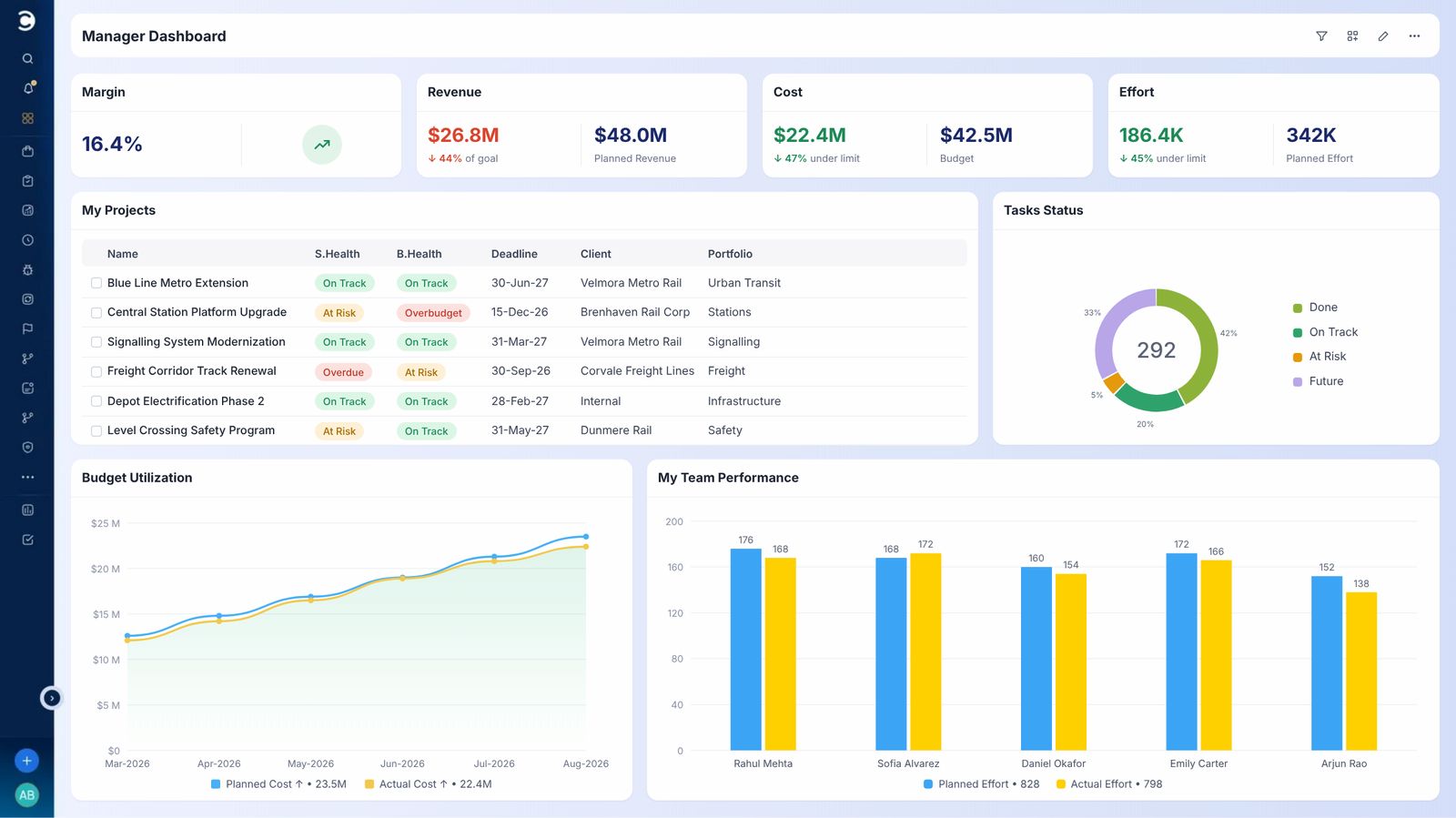
Celoxis is enterprise project portfolio management software, which makes it a layer 5 tool. It is built to sit above detailed schedulers and field tools and give the PMO one connected view of schedule, people, money and risk.
- Scheduling with critical path, baselines and cross-project dependencies, so interface links between contracts are visible and move together.
- Resource capacity planning across projects, with what-if analysis before you commit crews to a new package or bid.
- Financial tracking with budgets, actuals and earned value analysis, so cost and progress are read from the same data.
- Risk register with probability and impact scoring, and change request workflows with approval routing.
- Portfolio dashboards for PMO and executive reporting, built from live project data instead of a monthly deck.
- Cloud or on-premise deployment. Public owners with data residency rules can run Celoxis as on premise project management software, while contractors usually prefer a cloud based project management platform they can roll out fast.
- iOS and Android mobile apps, so supervisors can update progress from site instead of batching updates at the end of the week.
The same capabilities are covered in more depth, across other engineering sectors, in our guide to engineering project management software.
Where Celoxis is not the right tool
Honest positioning saves failed rollouts. Celoxis does not replace these rail tools, and you should not buy any PPM platform expecting it to.
- Possession booking and access planning. Track access is agreed through the infrastructure manager’s own process and systems. Celoxis can plan work to confirmed possession windows through calendars and constraints, but it does not allocate possessions.
- Linear time-location scheduling. Long track corridors are often planned on time-distance charts. Specialist linear scheduling tools draw these better.
- Contract programs that must be submitted in P6. Many rail clients require Primavera P6 programs under the contract. Keep P6 for the contract program and use Celoxis for the portfolio, resource and cost view above it.
- Design, BIM, signalling design, requirements assurance and formal document control. These belong in layer 3 tools built for that purpose.
If your team schedules in Microsoft Project today, the decision is different. Weigh the pros and cons of Microsoft Project for multi-package rail work, and if you are affected by the Project Online retirement, plan the move to a portfolio layer now rather than at contract renewal.
Worked example: one lost possession, three projects affected
This is an illustrative scenario, not customer data. A regional contractor runs three linked packages: a track renewal (Package A), a resignalling scheme (Package B) and a platform extension (Package C). In week 18, the infrastructure manager cancels a 54-hour weekend possession that Package A needed.
| What happens | Without a portfolio layer | With a portfolio layer |
|---|---|---|
| Package A | Planner re-baselines in P6 on Monday | Same re-plan; the slipped summary task updates in the portfolio tool |
| Package B | Learns at the weekly coordination meeting, five days later, that its testing start has moved | Its dependent milestone moves the same day through the cross-project link |
| Specialist crews | Signalling testers booked for week 19 sit idle | The resource view shows the testers as free in week 19, so they are redeployed |
| Package C | Platform works start on the old date and stop when track lowering is not done | Start date moves with the dependency; no abortive mobilization |
| Cost and risk | Finance sees the impact at month-end | The “possession refused” risk is marked as occurred, with its cost impact visible in the forecast |
| PMO and client | Revised forecast reaches the client at the next monthly report | Revised forecast is ready before the next coordination meeting |
The software did not save the possession. It saved the five days between the cancellation and everyone knowing about it, and in rail those days are where idle crews and abortive work pile up.
A 90-day rollout path for a rail PMO
A rail PMO can usually get a working portfolio layer live in about 90 days if it starts with structure and one real interface, not with data migration.
- Days 1 to 15: agree the structure. Define programs, packages and WBS levels, the stage gates you will enforce, and the five to eight reports executives actually read.
- Days 15 to 30: configure. Build templates, night and weekend calendars, roles and permissions, and the change request workflow. Import the shared resource pool.
- Days 30 to 60: pilot two linked packages. Pick packages with a real interface. Bring in schedule summaries from P6 at an agreed level of detail, usually milestones and interface tasks rather than every activity, and run them weekly.
- Days 60 to 90: add money and scale. Switch on budgets, actuals and earned value, extend to the remaining packages, and retire the monthly status spreadsheet.
The PMO owns this rollout, so it helps to be clear on what PMO software should and should not do for your team before day one.
Customer evidence: infrastructure work in Celoxis
Civil Seven is a Netherlands-based civil engineering firm that designs, draws and calculates models for underground and public transport infrastructure, including the EUR 380 million A9 tunnel project in Amsterdam. Before Celoxis, the team relied on internal tools, spreadsheets and basic software supplied by clients. With Celoxis it tracks progress, time and schedules in one platform, and it set up a complex project schedule in one week. Civil Seven is not a rail operator, but its problems are the ones rail teams describe: tight task sequencing, many parties, and risk that has to be managed early. Read the full Civil Seven success story.
FAQs
What is rail project management software? It is software for planning, resourcing, costing and governing rail infrastructure projects such as new lines, electrification, resignalling, stations and track renewals. In larger organizations it works as a stack, with a portfolio tool sitting above detailed schedulers, possession planners and field tools.
What is the best rail project management software? It depends on the layer you are missing. In my research, Celoxis is the strongest fit for the portfolio layer: one view of schedule, resources, cost and risk across many linked rail packages. Primavera P6 and Asta Powerproject lead on detailed contract scheduling, and Contruent and InEight lead on formal cost engineering for single megaprojects.
Is railway project management software the same as train scheduling software? No. Train scheduling and timetabling software plans train services and crews. Railway project management software plans the construction and renewal work that changes the railway.
Do we still need Primavera P6 if we buy a portfolio tool? Often, yes. Many rail contracts require P6 programs. A portfolio tool such as Celoxis sits above P6 and adds cross-project resources, money, risk and governance, usually using summary milestones and interface tasks from the P6 programs.
What features matter most for rail infrastructure projects? Non-standard work calendars, critical path with cross-project dependencies, resource capacity across packages, risks linked to milestones, earned value on live data, and enforced change and stage-gate workflows. For a wider checklist, see these key features of project management software.
Can project management software handle rail possessions? It can plan work to possession windows using calendars and date constraints, and show what moves when a possession is lost. Booking and allocating possessions stays with the infrastructure manager’s access planning process.
How does software reduce rail cost overruns? It cannot remove causes like geology or inflation. It shortens the time between a change and the people who need to act on it, so change orders, slipped work and weak estimates show up in the forecast while they are still cheap to correct.
How much does rail project management software cost? It depends on users, modules and deployment model, and portfolio features are often gated behind higher tiers. This project management software pricing comparison explains the common pricing models to check before you request quotes.
How long does implementation take for a rail PMO? About 60 to 90 days to reach a working portfolio layer for a first set of linked packages, depending on how many legacy tools are being replaced.
Choosing your rail project management software
Start with the layer you are missing, not the longest feature list. If your schedulers, possession planners and document systems work but nobody can see people, money and interfaces across packages, you are shopping for a portfolio layer. Run the six tests with your own data before you sign anything.


Comments
0 responses