

Germany runs some of the most complex projects in the world. A new vehicle platform in Wolfsburg, a custom packaging line in Baden-Württemberg and a plant upgrade in Ludwigshafen all tie hundreds of tasks, suppliers and engineers to fixed deadlines.
The scale is large. About 1.02 million people work in German mechanical and plant engineering companies with 50 or more staff, which makes it the country’s largest industrial employer (VDMA). The automotive industry employed about 732,000 people in 2025 and sold €534 billion of goods, around 68% of it abroad (VDA). At the same time, about 133,900 STEM jobs were still unfilled in March 2026 (IW MINT Report, Spring 2026).
Complex projects, scarce engineers and strict data rules make choosing project management software in Germany a different exercise. This guide shows how German industries pick a tool, what each sector needs, how the main German and international tools compare, and where Celoxis fits.
Quick answer: The best project management software in Germany depends on three filters: data protection (GDPR, BDSG and hosting location), industry fit (automotive stage gates, engineer-to-order work, capex projects) and scale (task tool or portfolio platform). Small teams often choose MeisterTask or awork. Public bodies often prefer OpenProject. Industrial PMOs that need scheduling, capacity and project financials in one place look at enterprise PPM tools such as Celoxis, Can Do or PLANTA.
Key takeaways
- German buyers check data protection first: where data is stored, who processes it and under which contract.
- Works councils have a say when software can monitor employee performance, so time tracking needs clear settings.
- Automotive, mechanical engineering and chemical companies need cross-project scheduling, capacity planning and cost control, not just task boards.
- Celoxis combines these in one platform, offers an EU data center and starts at $10 per user per month.
What Makes Project Management in Germany Different?
Project management in Germany is shaped by four things: strict data protection law, works council co-determination, a Mittelstand-heavy industrial base and a shortage of skilled engineers. Any tool that ignores one of these will meet resistance during rollout.
GDPR and BDSG make data protection the first filter
GDPR (General Data Protection Regulation) is the EU law on personal data. BDSG (Bundesdatenschutzgesetz) is Germany’s Federal Data Protection Act, which adds national rules, for example on employee data.
Project plans hold names, timesheets, rates and customer details, so they fall under both laws. German buyers usually ask three questions:
- Where is the data stored? EU or German data centers are preferred.
- Who processes it? The vendor must sign a data processing agreement under GDPR Article 28.
- Which jurisdiction is the vendor under? Some buyers also review the parent company’s home country.
GDPR does not strictly require data to stay in Germany. Transfers outside the EU are allowed with safeguards such as Standard Contractual Clauses. Still, many German companies, and almost all public bodies, choose EU hosting to keep audits simple. The choice between a cloud based project management platform and on premise project management software often comes down to this question.
Works councils (Betriebsrat) shape how time tracking is introduced
Under Section 87(1) No. 6 of the Works Constitution Act (BetrVG), the works council has a co-determination right on “the introduction and use of technical devices designed to monitor the behaviour or performance of the employees.” Project software with timesheets and utilization reports can fall under this rule.
In September 2022, the Federal Labour Court (BAG, case 1 ABR 22/21) also ruled that employers must record employees’ working time. German companies therefore need project tools with clear role permissions and configurable time tracking, and they should involve the works council early.
The Mittelstand and engineering culture favor structured, hybrid planning
Much of German industry is made up of family-owned, mid-sized companies, the Mittelstand. They value precision, documentation and formal approvals. Hardware projects follow phase gates and critical paths, while software and firmware teams work in sprints.
This is why hybrid planning matters. Teams need a waterfall schedule for the machine and an agile gantt chart for the software that runs it, in the same plan.
The skilled labor shortage turns capacity planning into a board topic
The IW MINT Report counted about 133,900 unfilled STEM vacancies in March 2026, with the largest gaps in energy and electrical jobs, metalworking, and mechanical and automotive engineering. When every engineer is scarce, double-booking one specialist across three projects delays all three.
That is why German PMOs increasingly invest in resource capacity planning software that shows demand against available hours before a project is approved.
A Three-Filter Framework for Choosing PM Software in Germany
Most German companies narrow their shortlist with three filters, in this order: compliance, industry fit and scale. A tool that fails the first filter rarely reaches a demo.
Filter 1: Compliance and hosting
Check these points before comparing features:
- EU or German hosting, or an on-premise option
- A GDPR Article 28 data processing agreement
- ISO 27001 and SOC 2 Type II reports
- Role-based permissions and configurable time tracking for works council approval
- Clear deletion and export of personal data
Filter 2: Industry fit
Next, match the tool to how your projects actually run. An automotive supplier needs stage gates and cross-project dependencies. A machine builder needs order-level cost tracking. A chemical company needs capex budgets and earned value. Use a list of the key features of project management software as a starting point, then add your sector’s must-haves.
Filter 3: Scale fit
Finally, decide which level of tool you need.
| Level | Typical user | What it handles | Examples |
|---|---|---|---|
| Task tool | Small teams, agencies | Boards, checklists, simple deadlines | MeisterTask |
| Team tool | Departments, creative teams | Workload, time tracking, team calendars | awork, Jira |
| Portfolio platform | PMOs, enterprise | Multi-project scheduling, capacity, budgets, portfolio reporting | Celoxis, Can Do, PLANTA |
If you run dozens of linked projects that share engineers and budgets, you are in enterprise project management territory. That usually calls for enterprise ppm software rather than a task board.
Project Management Software Needs by German Industry
Each German industry runs a different kind of project, so each needs a different mix of features. The sections below cover the five largest industrial sectors, then the other sectors that buy PM software in Germany.

Automotive (Volkswagen Group, BMW, Mercedes-Benz and their suppliers)
Germany’s carmakers and their Tier 1 and Tier 2 suppliers run vehicle programs with hard launch dates set by the OEM. Volkswagen Group (with Audi, Porsche and Lamborghini) is based in Wolfsburg, BMW in Munich and Mercedes-Benz in Stuttgart.
Typical project challenges:
- Stage gates and quality planning such as APQP, with formal sign-offs at each gate
- Hundreds of supplier deliverables feeding one start of production date
- Engineering changes that ripple across parallel programs
- Information security demands from OEMs
TISAX (Trusted Information Security Assessment Exchange) is the automotive industry’s information security assessment, based on ISO 27001 and the VDA ISA catalog and managed by the ENX Association. OEMs such as Audi, BMW and Volkswagen ask suppliers to pass it. Your PM tool’s hosting and security reports will be part of that review.
Must-haves: critical path scheduling, cross-project dependencies, approval workflows and portfolio dashboards. Strong supply chain in project management and links to product life cycle management software keep supplier and engineering milestones in one view. Celoxis supports this with dependency-driven scheduling and portfolio-level reporting.
Mechanical Engineering and Industrial Equipment
German machine builders make high-precision tools, robots and production lines, often as engineer-to-order projects. Most are Mittelstand companies that run many customer orders at once with the same small pool of designers, electricians and commissioning engineers.
Typical project challenges:
- Every order is a project with its own design, build, delivery and commissioning phases
- The same specialists are needed on several orders in the same week
- Margins disappear when hours and travel costs are not tracked per order
Must-haves: multi-project resource planning, time and expense tracking, and budget versus actual per order. Generic project management software for manufacturing helps, but engineering PMOs searching for the top software for identifying bottlenecks in engineering projects need capacity views across all orders. Celoxis shows resource load across projects and tracks time, expenses and costs against each project budget.
Chemicals and Pharmaceuticals (BASF, Bayer)
Germany’s chemical and pharmaceutical industry employs more than 560,000 people and had sales of about €240 billion in 2024. In 2025, chemical plants ran at only about 70% capacity, a historic low (VCI). BASF is based in Ludwigshafen and Bayer in Leverkusen.
Typical project challenges:
- Capex projects for new plants, debottlenecking and plant turnarounds
- R&D pipelines with long timelines and stage gates
- Strict documentation for regulated production
- Pressure to prove return on every investment while capacity is low
Must-haves: capex budgets, cost control and earned value tools that show cost and schedule performance together, plus project risk software for safety and regulatory risks. Celoxis includes earned value analysis and real-time budget versus actual tracking.
Electrical and Electronics (Siemens, Bosch)
Companies such as Siemens (Munich) and Bosch (Gerlingen, near Stuttgart) build industrial automation, power equipment and medical technology. Their projects mix hardware, firmware and software.
Typical project challenges:
- Hardware teams plan in phases while software teams run sprints
- Energy and grid projects tied to Germany’s energy transition
- Regulated medical technology development
Must-haves: hybrid waterfall and agile planning, portfolio reporting and clear governance. Teams working on renewable energy project management or medical device project management software need both a long-term schedule and sprint-level detail. Celoxis supports waterfall and agile work in one platform.
Food and Beverages
Germany is known for beer, sausages and confectionery brands such as Haribo. It had 1,415 breweries in 2025, 588 of them in Bavaria, down 137 from 2019 (Destatis).
Typical projects include plant upgrades, packaging line changes, product launches and seasonal capacity planning. Most of these are repeatable, so templates and approval steps matter. Good workflow management software helps standardize launches across sites.
Public Sector, IT, Healthcare and Logistics
- Public sector: Federal and state bodies put data sovereignty first and often choose open-source tools such as OpenProject. Teams comparing government project management software should check hosting, accessibility and procurement rules.
- IT and software: Tech firms lean on agile boards and issue trackers such as Jira.
- Healthcare and insurance: These sectors handle sensitive personal data, so they prefer EU-hosted or self-hosted healthcare project management software.
- Logistics: Hamburg’s port and Germany’s transport networks need logistic project management that coordinates sites, vendors and fixed windows.
Industry requirements at a glance
| Industry | Typical projects | Biggest pain point | Must-have features | Usual tool level |
|---|---|---|---|---|
| Automotive | Vehicle programs, supplier launches | Linked deadlines across programs | Stage gates, dependencies, portfolio dashboards | Portfolio platform |
| Mechanical engineering | Engineer-to-order machines, plant engineering | Specialists booked on too many orders | Capacity planning, time and expenses, cost per order | Portfolio platform |
| Chemicals and pharma | Capex plants, turnarounds, R&D | Proving return on investment | Earned value, budgets, risk tracking | Portfolio platform |
| Electrical and electronics | Automation, energy, medtech | Hardware and software out of sync | Hybrid planning, governance | Portfolio platform |
| Food and beverages | Line upgrades, launches | Repeating work by hand | Templates, workflows | Team tool or portfolio platform |
| Public sector | Digital and infrastructure programs | Data sovereignty | Self-hosting or EU hosting | Team tool or open source |
| IT and software | Releases, sprints | Silos from the business | Agile boards, issue tracking | Team tool |
Germany’s Industrial Hubs at a Glance
Project needs in Germany also follow geography. Bavaria and Baden-Württemberg lead in automotive and machinery, the Rhine area in chemicals, and Berlin and Hamburg in public sector, tech and logistics.
| City or region | State | Key industries | Notable companies | Main PM priority |
|---|---|---|---|---|
| Munich, Ingolstadt | Bavaria | Automotive, electrical, software | BMW, Audi, Siemens | Program and supplier coordination |
| Stuttgart and region | Baden-Württemberg | Automotive, machinery, automation | Mercedes-Benz, Porsche, Bosch | Engineering capacity across projects |
| Wolfsburg | Lower Saxony | Automotive | Volkswagen Group | Vehicle launch programs |
| Ludwigshafen | Rhineland-Palatinate | Chemicals | BASF | Capex and turnaround projects |
| Leverkusen, Cologne, Düsseldorf | North Rhine-Westphalia | Chemicals, pharma, steel, engineering | Bayer | Plant and R&D portfolios |
| Frankfurt | Hesse | Finance, chemical parks | Banks, industrial park operators | Compliance and governance |
| Berlin | Berlin | Public sector, tech | Federal ministries, OpenProject, Planio | Data sovereignty |
| Hamburg | Hamburg | Logistics, aerospace, media | Port operators, awork | Multi-site coordination |
Munich is also home to several German PM vendors, including MeisterLabs (MeisterTask), Can Do and Actano (RPLAN), while PLANTA is based in Karlsruhe.
Top Project Management Software Used in Germany
The German market splits into five groups: German task and team tools, German open-source tools, German enterprise PPM suites, international work tools and integrated enterprise PPM platforms such as Celoxis. Each group solves a different problem.
German task and team tools: MeisterTask and awork
MeisterTask is a Kanban-style task manager from MeisterLabs in Munich. Its servers sit in an ISO 27001-certified data center in Germany. It is easy to learn and strong for team task flows, but it is not built for multi-project scheduling or project financials.
awork is a Hamburg-based platform for agencies and project-based teams. It combines planning, time tracking and workload views, and it is hosted on ISO 27001-certified Microsoft servers in Germany. It fits creative and service teams more than industrial PMOs.
German open-source and sovereign tools: OpenProject and Planio
OpenProject is a Berlin-based open-source project management tool with Community and Enterprise editions. It can run on-premises or in its cloud, with no personal data stored outside the EU, and it is part of the openDesk workplace for the public sector. Self-hosting gives full control but needs IT effort.
Planio is a Berlin-based hosted version of the open-source Redmine tracker. Data is hosted in an ISO 27001 data center in Germany. It suits technical teams that want issues, code and a help desk in one place.
German enterprise PPM suites: Can Do, PLANTA, RPLAN and Projektron BCS
- Can Do (Munich, founded 2000) offers AI-supported project, portfolio and skill-based resource planning. SaaS runs on AWS servers in Frankfurt, with on-premise on request.
- PLANTA (Karlsruhe) has built multi-project management software for over 40 years, for sectors including mechanical engineering, automotive and pharma, on-premise or as SaaS.
- RPLAN by Actano (Munich) is focused on complex projects, mainly in automotive, mechanical engineering, plant construction and aerospace.
- Projektron BCS (Berlin) combines project management with time tracking, invoicing and CRM for more than 800 customer organizations, on-premise or SaaS.
These suites are powerful, but implementations are often long and need consultants.
International tools: Jira, Smartsheet and Microsoft Project
Jira (Atlassian) is the standard for software teams. Atlassian lets Standard, Premium and Enterprise customers pin data to Germany (Frankfurt) or the EU, though user account data stays global. Jira handles sprints well, but finance and resource views across the business need add-ons or other project resource management software.
Smartsheet offers a spreadsheet-style work platform with an EU region hosted in Germany and backed up in Ireland. It is flexible, but large multi-project budgets and capacity models take extra setup.
Microsoft Project has long been common in German engineering firms. Microsoft retired Project Online on September 30, 2026, and points customers to the new Planner. Companies affected by the project online retirement should review the pros and cons of microsoft project before choosing a replacement.
Celoxis: integrated enterprise PPM with an EU data center
Celoxis project management software combines scheduling, resource capacity planning, time and expense tracking, project financials and portfolio reporting in one platform. Customers can choose a Europe data center (eu.celoxis.com), and Enterprise customers can deploy on-premise. Celoxis is GDPR-ready and holds SOC 2 Type II and ISO 27001 certifications (Celoxis GDPR). Plans start at $10 per user per month (Celoxis pricing).

Comparison Table: Celoxis vs German and International PM Tools
The table compares 12 tools German companies shortlist most often, on hosting, multi-project depth, financials and pricing model. Details reflect public vendor information as of October 2026.
| Tool | HQ | Best for | Hosting and deployment | Multi-project and capacity | Project financials | Pricing model | Watch out for |
|---|---|---|---|---|---|---|---|
| Celoxis | International | Mid-size to large PMOs | Cloud (US or EU data center) or on-premise (Enterprise) | Strong: cross-project scheduling and capacity | Strong: budget vs actual, earned value, time and expenses | From $10 per user per month; Enterprise by quote | Smaller German partner network than local vendors |
| OpenProject | Berlin | Public sector, sovereignty-first teams | Self-hosted or EU cloud | Moderate | Basic cost and time reporting | Free Community edition; paid Enterprise | Self-hosting needs IT effort |
| awork | Hamburg | Agencies, service teams | Cloud on German servers | Team workload | Basic: time tracking | Per-user subscription | Not built for industrial portfolios |
| MeisterTask | Munich | Small teams, task flows | Cloud on German servers | Limited | Limited | Per-user subscription | Kanban focus, no multi-project scheduling |
| Can Do | Munich | Resource-heavy portfolios | AWS Frankfurt or on-premise | Strong: AI and skill-based planning | Moderate | Per-user tiers; on-premise by quote | Setup and training effort |
| PLANTA | Karlsruhe | Engineering and R&D portfolios | On-premise or SaaS | Strong | Included | By quote | Long enterprise rollout |
| RPLAN (Actano) | Munich | Large automotive programs | Enterprise deployment | Strong for programs | Program-level | By quote | Narrow industry focus |
| Projektron BCS | Berlin | Service and engineering firms | On-premise or SaaS | Moderate to strong | Strong: time, invoicing | License or SaaS by quote | Broad ERP-like scope adds setup |
| Planio | Berlin | Technical and dev teams | Cloud on German servers | Limited | Limited | Team-based plans | Issue-tracker focus |
| Jira | Australia and US | Software teams | Cloud with Germany or EU data residency | Needs add-ons | Needs add-ons | Free for small teams; paid per user | Business finance lives elsewhere |
| Smartsheet | US | Flexible grid workflows | Cloud with EU region in Germany | Moderate with setup | Moderate with setup | Per-user subscription | Complex models need extra setup |
| Microsoft Project | US | Classic scheduling | Project Online retired Sept 30, 2026; new Planner | Moderate | Basic | Microsoft 365 plans | Migration now required |
For a wider project portfolio management software comparison, see our full guide.
Key takeaways from the comparison
The local challengers. MeisterTask, awork, OpenProject and Planio win on German hosting and simplicity. They fit small and mid-size teams and the public sector, but they are not built for portfolio finance and cross-project capacity.
The German enterprise suites. Can Do, PLANTA, RPLAN and Projektron BCS handle complex portfolios. They often need long implementations and consultants.
The international heavyweights. Jira and Smartsheet now offer German or EU data residency, so hosting is less of a blocker than before. Their gap is scope: Jira stays inside software teams, and Smartsheet needs heavy setup for budgets and capacity.
Where Celoxis fits. Celoxis sits between these groups. It gives PMOs enterprise scheduling, capacity planning and project financials in one platform, with an EU data center option and a faster start than traditional suites.
Common Pain Points German Companies Face with Their Current Tools
Most German industrial companies do not lack software. They have too many disconnected tools, and the PMO spends its week reconciling them.
- Excel islands. Each project manager keeps a private spreadsheet, so portfolio reports are rebuilt by hand every month.
- Jira silos. Engineering progress is visible in Jira, but cost, capacity and customer milestones live somewhere else.
- No portfolio finance. Task tools show what is late but not what it costs, so margin per project stays unknown until the order closes.
- Long enterprise rollouts. Traditional PPM suites can take many months and outside consultants before the first portfolio report.
- Overbooked specialists. Without a shared capacity view, the same commissioning engineer is planned on three sites in one week.
- Works council friction. Time tracking that was not explained or configured early slows approval and adoption.
The common fix is to replace fragmented tools with one system of record. For organizations running linked projects, dedicated program manager software gives one view of dependencies, people and money.
Why Celoxis Fits German Industrial PMOs
Celoxis is built for PMOs that need scheduling, people and money in one place, which is exactly where German industrial firms feel the most pain.
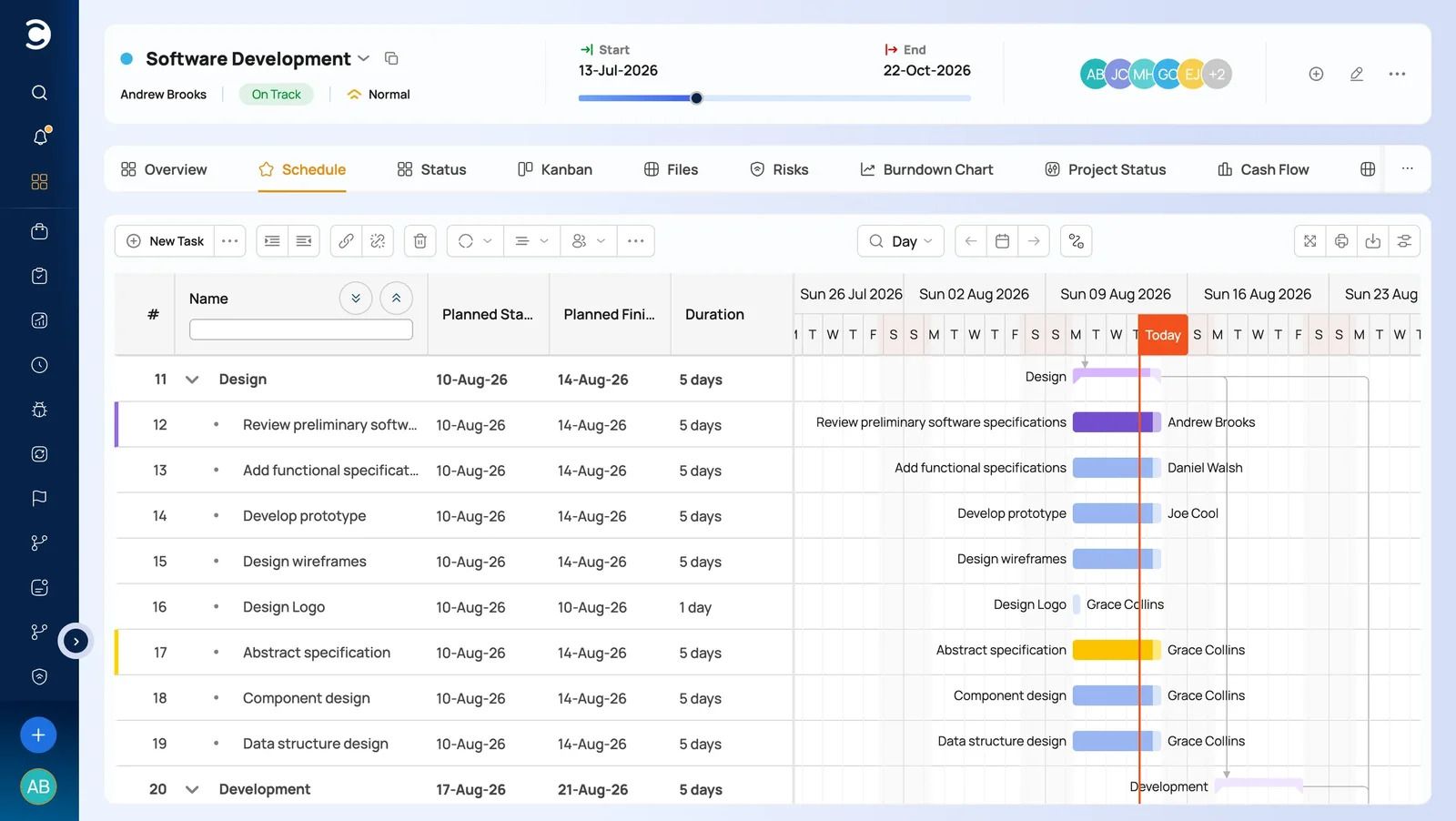
One platform for scheduling, capacity, time, expenses and financials
Celoxis brings task scheduling, cross-project dependencies, resource capacity planning, time and expense tracking and project costing into one system. Budget versus actual, project profitability and earned value update as work is logged, so the PMO does not rebuild reports by hand. Managers can drill down from a portfolio dashboard to a single task.
Hybrid waterfall and agile planning
Hardware teams can plan phases and critical paths while software teams run sprints, in the same portfolio. This matches how German automotive, electrical and machinery companies actually build products.

Data protection that fits German buyers
- Europe data center option (eu.celoxis.com)
- On-premise deployment for Enterprise customers
- GDPR-ready, with a data processing addendum that includes EU Standard Contractual Clauses
- SOC 2 Type II and ISO 27001 certified
- Role-based permissions that help you set up time tracking with your works council
AI that answers portfolio questions
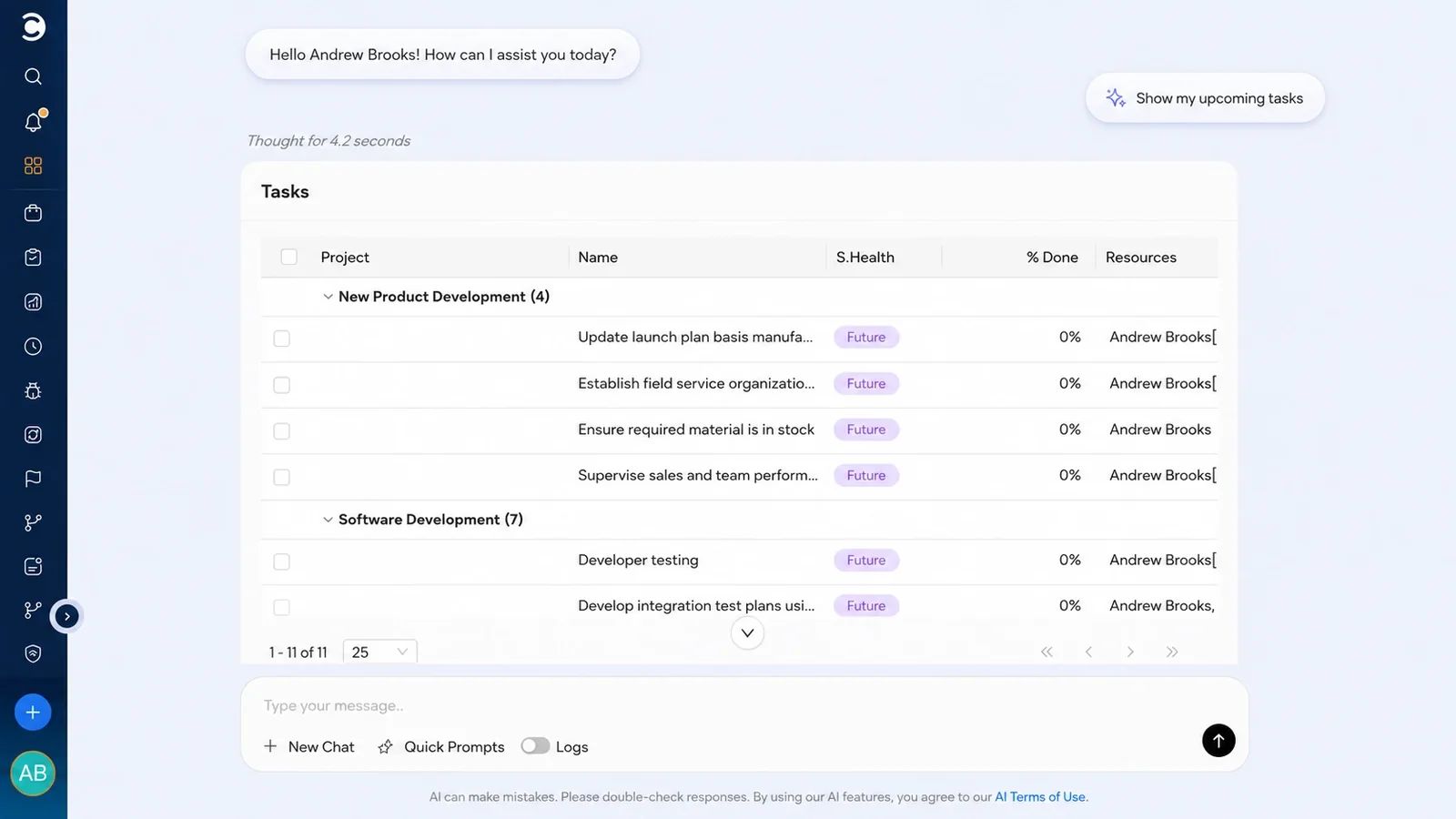
Celoxis includes an AI assistant that answers questions about projects and resources in plain English. A Celoxis MCP server (beta) also connects Celoxis data to ChatGPT Desktop, Claude Desktop and Cursor, following each user’s permissions. Teams can also work on the go with the Celoxis mobile app.
Governance for strategic portfolios
Approval workflows, portfolio prioritization and drill-down reporting support strategic project management across business units. You can read what PMOs say about it in celoxis reviews.
When Celoxis may not be the right fit
- A small team that only needs a Kanban board will be well served by a simpler tool such as MeisterTask.
- A public body that must run open-source software on its own servers may prefer OpenProject.
- A company that wants a vendor headquartered in Germany, with a local partner network, may lean toward PLANTA, Can Do or Projektron.
Customer story: RheinBrücke Consulting moves from Microsoft Project to Celoxis
RheinBrücke Consulting is a German technology consulting firm that runs product and software development projects for its clients. The team had been managing work in Microsoft Project and Project Server, the same setup many German engineering firms are now replacing.
The challenge
- Resources were hard to allocate across specialized teams.
- Limited real-time collaboration reduced transparency between locations.
- Time tracking for invoicing and project analysis was slow and error-prone.
The results with Celoxis
| Metric | Improvement |
|---|---|
| Resource-driven delays | 30% reduction |
| On-time project deliveries | 25% increase |
| Overall project management efficiency | 35% improvement |
| Invoicing accuracy | 20% improvement |
“Celoxis has been a game-changer for our project management processes.” (John Ephrame, RheinBrücke Consulting)
Read the full RheinBrücke Consulting success story.
How to Evaluate PM Software in Germany: A 7-Step Checklist
A structured evaluation helps you avoid an expensive second migration. Follow these seven steps.
- Map your data and hosting needs. Decide whether EU cloud, German cloud or on-premise is required, and ask each vendor for its data processing agreement and security reports.
- Bring in the works council early. Share how time tracking, utilization reports and permissions will work before the pilot starts.
- List your cross-project dependencies. Note which projects share engineers, suppliers or test benches.
- Define the financial KPIs you need. For example budget versus actual, margin per project, earned value or capex burn.
- Test capacity planning with real data. Load next quarter’s projects and check whether the tool shows overbooked roles before you approve work.
- Check integrations. Confirm how the tool connects with your ERP, Jira, Microsoft 365 and identity provider.
- Run a pilot with one portfolio. Pick one business unit, run it for six to eight weeks and measure reporting time saved.
Conclusion: Choose for Compliance, Industry Fit and Scale
Choosing project management software in Germany comes down to three filters. First, confirm data protection: hosting, contracts and works council readiness. Second, match the tool to how your industry runs projects, from automotive stage gates to engineer-to-order machines and capex plants. Third, pick the right scale, because a task board cannot run a portfolio.
For German industrial PMOs that need scheduling, capacity planning and project financials in one platform, with an EU data center option, Celoxis is a strong place to start.
Know more
- What is project management software?
- Most popular project management software
- Best PMO software
- Gantt charts in project management
- Project portfolio management software guide
- Web-based project management software
- Project management collaboration software
- Work management software
- Resource management and scheduling tools
- Project management office (PMO) guide


Comments
0 responses