

Semiconductor Project Management Software: How Chip Companies Run Programs, People, and Budgets in One System
Quick answer
Semiconductor project management software is the system a chip company uses to plan, staff, track and govern its programs from spec to production ramp. It sits above EDA, PLM and IP management tools. Those tools manage design data. This layer manages schedules, engineers, money and risk across every program at once.
Key takeaways
- Tape-out is a midpoint, not the finish line. Bring-up, validation, qualification and ramp belong in the same plan.
- Most chip companies already run EDA tools and a PLM. What they lack is one place where schedule, capacity, cost and risk roll up across programs.
- We scored 8 tools on 7 weighted criteria. Celoxis scored 88 out of 100, Planview Portfolios 79.5 and ONES.com 69.5.
- Pick by the job. PLM for design data. Jira for software sprints. An execution platform for program delivery and portfolio decisions.
What is semiconductor project management?
Semiconductor project management is the planning, staffing, tracking and governance of chip programs. A program covers everything from the first spec to volume production. It spans architecture, design, verification, physical design, tape-out, fabrication, packaging, validation, qualification and ramp.
Three levels matter:
- Project: one block, one test chip, one validation campaign.
- Program: one product, such as an SoC, with many linked projects. See the difference between program and project management.
- Portfolio: every program the company funds, competing for the same engineers, tools and fab slots.
The work looks different by company type. Fabless design houses manage design teams and foundry partners. IDMs add their own fabs. OSATs run packaging and test programs for many customers. Equipment makers run customer-specific builds with engineering change at every step. All of them share one problem: many programs, few experts, hard dates.
Why chip programs are hard to run
Chip programs fail on coordination more often than on engineering. Five pressures show up again and again.
- Too many systems. Siemens cites Tech-Clarity research showing that >more than 60% of semiconductor companies use six or more systems to manage product data and processes. Status lives in spreadsheets, trackers and email. The cost is reconciliation time, which is why many PMOs now replace fragmented tools with one execution platform.
- Deep dependencies. One late IP block moves verification, which moves sign-off, which moves the tape-out slot. Plans need real dependency logic, not static dates. A good project scheduling software handles this; a spreadsheet does not.
- Scarce, shared engineers. Verification, physical design and product engineering teams serve several programs at once. One overloaded team delays the next handoff.
- Tape-out is only halfway. One industry executive told SemiEngineering that tape-out is >roughly halfway through the project, and that the second half is where costs climb. PTC makes a similar point: the biggest >delays after tape-out often come from downstream coordination, not chip design.
- High cost of a slip. At advanced nodes, >mask sets can run into the tens of millions of dollars and market windows last a few quarters. Leaders need to know what a program costs, not just when it ships. That is where project cost management software earns its place.
Partner work adds more risk. Foundries, OSATs and IP suppliers each run their own schedules. Treat them as part of your plan, the way you would in supply chain project management.
Where project management software fits: the layer model
Project management software does not replace your design or data tools. It sits above them and runs the delivery.
| Layer | Typical tools | What it manages | Main users |
|---|---|---|---|
| Design | EDA suites (Synopsys, Cadence, Siemens EDA) | RTL, simulation, layout, physical verification | Design and verification engineers |
| Design data | IP lifecycle management (for example Perforce IPLM), version control | IP blocks, versions, design hierarchy, reuse | Design and CAD teams |
| Product data | PLM (for example Siemens Teamcenter, PTC Windchill) | BOMs, mask and reticle data, change records, compliance | Engineering operations, quality |
| Requirements | Requirements tools (for example Jama Connect, Polarion) | Requirements and traceability | Systems engineers |
| Engineering tasks | Jira, Azure DevOps | Firmware and software tickets, sprints, bugs | Software teams |
| Execution and portfolio | Celoxis, Planview | Schedules, capacity, time, cost, risk, gates, portfolio rollups | PMO, program managers, leadership |
The execution layer is the only one built to answer leadership questions across programs. Which programs are at risk? Where does engineering capacity run out next quarter? What has each program cost so far? A PLM answers “what is the current mask revision?” An execution platform answers “will we hit the customer sample date, and what will it take?”
For a deeper look at the product data side, see our guide to product life cycle management software.
The semiconductor program lifecycle, stage by stage
Most chip programs move through nine stages. Each one ends with a gate: a decision to continue, change course or stop.
| Stage | What happens | Gate question | What the PMO tracks |
|---|---|---|---|
| 1. Concept and spec | Market need, target specs, business case | Is this worth funding? | Business case, staffing estimate, target dates |
| 2. Architecture | Block diagram, IP choices, power and area budgets | Is the architecture feasible on time? | IP make or buy decisions, risk register |
| 3. RTL design and verification | Code the design, build test benches, close coverage | Is the design complete and verified? | Coverage trend, bug trend, verification capacity |
| 4. Physical design and sign-off | Synthesis, place and route, timing closure, DRC | Is it ready for tape-out? | Timing closure risk, sign-off checklist |
| 5. Tape-out | Final design data released to the foundry | Is the data clean and approved? | Tape-out date, foundry slot, mask cost |
| 6. Fab and packaging | Wafers made at the foundry, assembly and test at the OSAT | Are partners on schedule? | Partner milestones, shipping dates |
| 7. Bring-up and post-silicon validation | First silicon powered on and tested | Does it work as specified? | Validation plan, open issues, lab capacity |
| 8. Qualification and characterization | Reliability tests, corner testing, customer samples | Is it ready for customers? | Qualification results, sample dates |
| 9. Production ramp | Yield learning, volume manufacturing | Can we ship at volume and cost? | Ramp milestones, cost per unit trends |
Two planning habits make this work:
- Track gates as milestones, not as notes in a slide. Each gate has an owner, criteria and a date that moves with the schedule.
- Give dates with confidence levels. AnySilicon advises that when management asks for one tape-out date, it should come >with a probability and a risk explanation. Planning software that links tasks makes this possible, because a change in one block shows its impact on every date after it. Gantt charts in project management help teams see that chain at a glance.
What to look for: the 7 criteria we used
We scored each tool on seven criteria. Each criterion gets a score from 1 to 10. The weight sets how much it counts toward the total out of 100.
| # | Criterion | Weight | Why it matters for chip programs | What to test in a trial |
|---|---|---|---|---|
| 1 | Multi-program scheduling with dependencies | 20% | Slips in one block ripple across programs | Link two programs that share an IP block. Move one date. Watch what updates. |
| 2 | Role-based capacity and resource planning | 20% | Verification and physical design teams are the usual bottleneck | Plan demand by role (not by name) for the next two quarters |
| 3 | Time, cost and financial tracking | 15% | Leaders need program cost, not just dates | Log time against a program and see cost update without a spreadsheet |
| 4 | Governance, gates and workflows | 15% | Gate decisions and approvals get lost in email | Set up a gate review with approvers and an audit of who decided what |
| 5 | Portfolio reporting and drill-down | 15% | Weekly reviews need trusted rollups | Build a portfolio dashboard, then drill from a red program to the task that caused it |
| 6 | Deployment and data control | 10% | Chip IP is sensitive; some teams need self-hosting | Confirm cloud regions and on-premises options |
| 7 | Adoption and time to value | 5% | A tool engineers avoid gives you stale data | Ask an engineer to update a task on day one |
A few related guides go deeper on single criteria: project management scheduling techniques, project budgeting software, earned value management, portfolio governance for enterprise PMOs, project risk management software and cloud versus on-premise project management software.
Scores at a glance
| Rank | Tool | Type | Best for | Score (out of 100) |
|---|---|---|---|---|
| 1 | Celoxis | Execution and portfolio platform | PMOs running many chip programs on shared engineers | 88 |
| 2 | Planview Portfolios | Enterprise strategic portfolio management | Very large enterprise PMOs | 79.5 |
| 3 | ONES.com | R&D and software delivery platform | R&D teams that need requirements and private deployment | 69.5 |
| 4 | Siemens Teamcenter Semiconductor Lifecycle Management | Semiconductor PLM | PLM-led NPI and design data | 61 |
| 5 | Microsoft Project and Planner | Scheduling tool | Single detailed schedules | 59.5 |
| 6 | Wrike | Work management | Cross-functional request and task flow | 59 |
| 7 | Smartsheet | Spreadsheet-style work management | Teams that think in grids | 58 |
| 8 | Jira | Issue tracking | Firmware and software sprints | 44.5 |
Full scoring table
| Tool | Scheduling (20%) | Capacity (20%) | Cost (15%) | Governance (15%) | Reporting (15%) | Deployment (10%) | Adoption (5%) | Total |
|---|---|---|---|---|---|---|---|---|
| Celoxis | 9 | 9 | 9 | 8 | 9 | 9 | 8 | 88 |
| Planview Portfolios | 7 | 9 | 9 | 8 | 9 | 6 | 5 | 79.5 |
| ONES.com | 7 | 6 | 5 | 8 | 7 | 10 | 7 | 69.5 |
| Siemens Teamcenter SLcM | 6 | 5 | 5 | 9 | 7 | 5 | 5 | 61 |
| Microsoft Project and Planner | 9 | 5 | 6 | 4 | 5 | 6 | 6 | 59.5 |
| Wrike | 6 | 6 | 5 | 6 | 7 | 4 | 8 | 59 |
| Smartsheet | 6 | 6 | 5 | 5 | 7 | 4 | 9 | 58 |
| Jira | 4 | 4 | 3 | 6 | 5 | 4 | 7 | 44.5 |
How the total works: each score is multiplied by its weight, then the results are added. Example for Celoxis: (9 x 20) + (9 x 20) + (9 x 15) + (8 x 15) + (9 x 15) + (9 x 10) + (8 x 5) = 880, divided by 10 = 88.
The 8 best semiconductor project management software tools in 2026
1. Celoxis: best for PMOs running many chip programs on shared engineers (88/100)
Celoxis is a Mission-Critical Execution OS. It brings every project, resource, budget and risk into one execution platform, so program schedules, engineering capacity, time and cost stay connected without manual reconciliation.
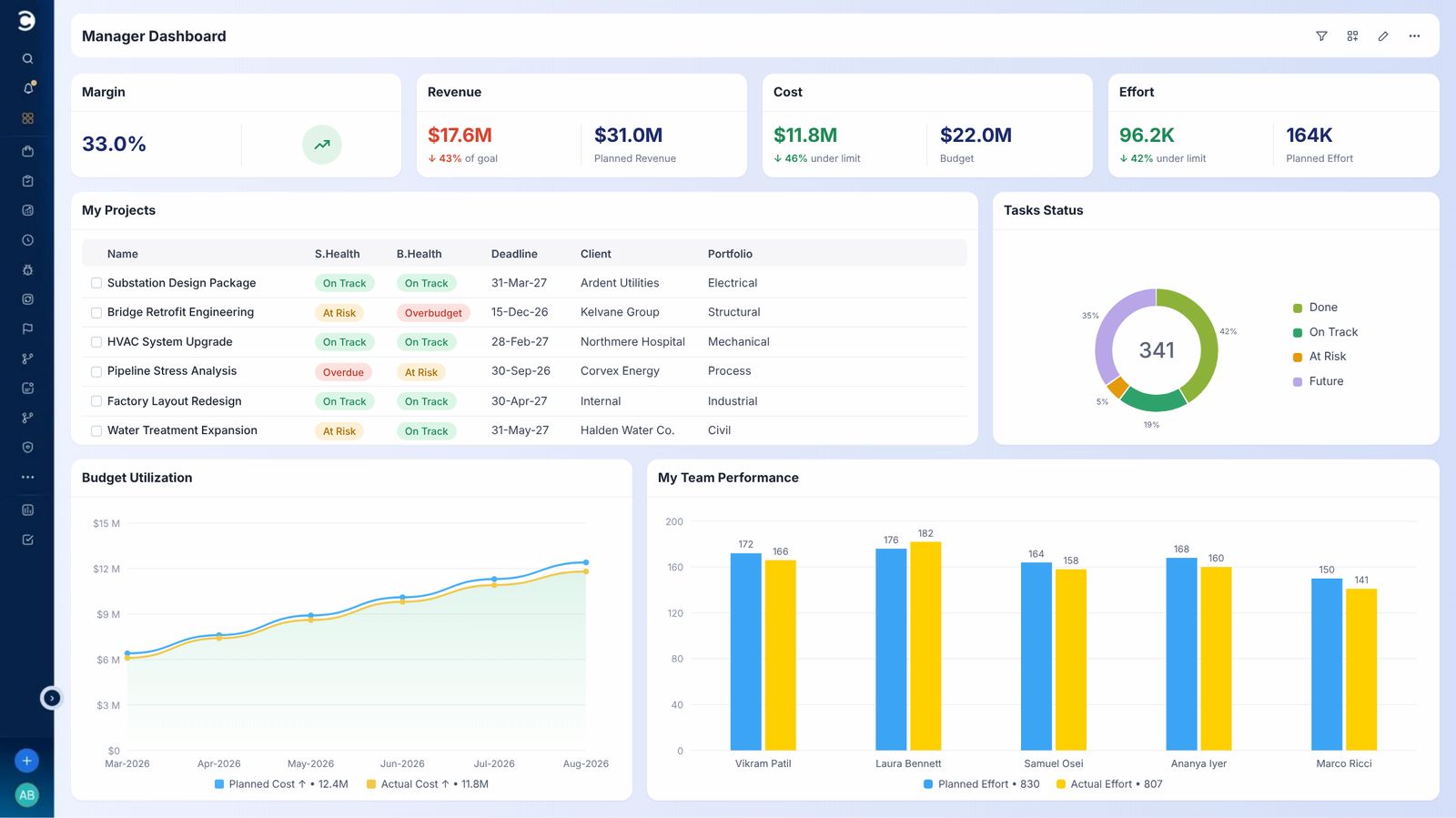
Best for: semiconductor PMOs, program directors and operations leaders who run several programs at once and need trusted portfolio answers every week.
Strengths for chip programs:
- Scheduling built for dependencies. Plans carry task dependencies, constraints and milestones, so a slip in one block shows its effect on tape-out and every date after it.
- Capacity by role. Plan verification, physical design and validation demand across programs before you commit a date. See how this works in our capacity planning software.
- Time and cost in the same system. Timesheets, budgets and costs roll up to program and portfolio level, so finance and the PMO read the same numbers.
- Governance you can trace. Approval workflows support gate reviews, and decisions stay attached to the program, not buried in email.
- Dashboards with drill-down. Leaders open a portfolio view, click a red program and see the task, owner and dependency behind it.
- Deployment choice. Run it in the cloud, with data centers in the US and the EU, or host it yourself with on-premise deployment. That matters when design IP must stay inside your network.
- Fits your existing stack. Listed integrations include Jira, Azure DevOps, GitHub, Microsoft Project import, Excel and a REST API, with SAML single sign-on.
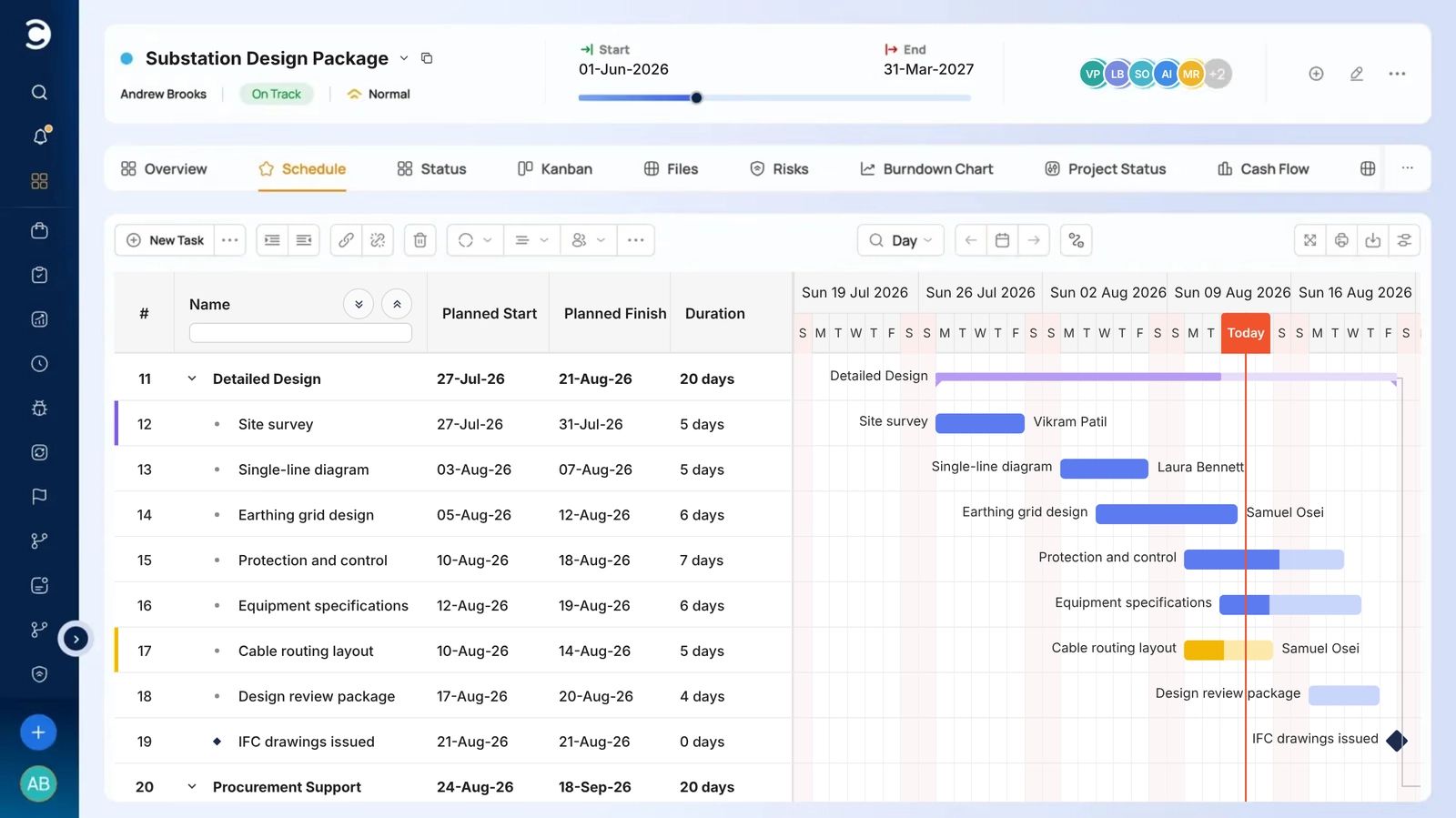
Watch-outs: Celoxis is not a PLM or an EDA tool. It does not manage design files, IP blocks or mask data. Keep those in your design and PLM systems and let Celoxis run the delivery around them. Software teams that live in Jira can keep it for sprints while program status rolls up in Celoxis.
Proof from hardware makers: Celoxis does not yet have a published semiconductor case study. Two published stories come from instrument and equipment makers with similar delivery problems:
- Edinburgh Instruments, a maker of spectroscopic instruments in Scotland, moved complex multi-phase projects off Excel. The company reports a 30% increase in transparency, 25% more efficient resource planning and 15% more accurate cost reporting.
- Markem-Imaje, an industrial coding and marking company, uses Celoxis to compare resource forecasts with actuals and run clearer monthly portfolio reviews.

Celoxis supports 400+ active customers and stays with teams through adoption, with human experts and a guided trial.
2. Planview Portfolios: best for very large enterprise PMOs (79.5/100)
Planview Portfolios is an enterprise portfolio platform. Its >product page highlights demand management, capacity planning and funding across programs, products and features.
Best for: large enterprise PMOs and EPMOs that run strategic portfolio planning across IT, R&D and business units.
Strengths: strong portfolio prioritization, scenario planning and capacity planning; financial planning at portfolio level.
Watch-outs: it is a broad enterprise suite. Plan for a longer rollout and dedicated administrators. Confirm hosting options and detailed scheduling depth for chip programs during your evaluation.
3. ONES.com: best for R&D teams that need requirements and private deployment (69.5/100)
ONES.com is a platform for product, project, software development and knowledge management. Its own materials list >Cloud, On-Premise, Private Cloud and Air-gapped deployment options.
Best for: semiconductor R&D groups that want requirements, tasks, reviews and documentation in one place, with strict control over where data lives.
Strengths: requirements and delivery workflows together; deployment flexibility, including air-gapped setups; free plan for small pilots.
Watch-outs: the product centers on product and software delivery. Test the depth of role-based capacity planning, program cost tracking and portfolio financials before you use it for funding decisions.
4. Siemens Teamcenter Semiconductor Lifecycle Management: best for PLM-led NPI (61/100)
Teamcenter Semiconductor Lifecycle Management is a preconfigured SaaS PLM. Siemens lists NPI project templates, phase-gate status reports and IP library traceability among its capabilities.
Best for: chip companies that want NPI planning tied directly to design data, mask and reticle data, and change records.
Strengths: deep product data management; traceability for IP; out-of-the-box NPI metrics.
Watch-outs: it is a PLM first. Cross-portfolio capacity planning, time tracking and project financials for work outside NPI (customer programs, IT, facilities) usually need another layer. Many teams pair a PLM with an execution platform.
5. Microsoft Project and Planner: best for single detailed schedules (59.5/100)
Microsoft Project desktop remains a strong tool for one detailed, dependency-driven schedule. Project Online, Microsoft’s cloud PPM service, retired on September 30, 2026. Read our note on Project Online’s retirement and the best alternatives.
Best for: a scheduler who owns one complex plan.
Strengths: critical path scheduling; wide familiarity.
Watch-outs: multi-program capacity, cost rollups and governance need extra tools or manual work. See 13 reasons to stop using Microsoft Project for the common limits, and our guide to migrate from Microsoft Project to Celoxis if you are moving.
6. Wrike: best for cross-functional request and task flow (59/100)
Wrike is a cloud work management platform used by marketing, operations and product teams.
Best for: teams that need request intake, task flow and shared dashboards across departments.
Strengths: flexible workflows; fast to set up; good collaboration features.
Watch-outs: cloud only. Test multi-program dependency scheduling and cost control against a real chip program. Compare options in our list of Wrike alternatives.
7. Smartsheet: best for teams that think in grids (58/100)
Smartsheet is a cloud, spreadsheet-style work management tool.
Best for: teams moving off Excel who want a familiar grid with shared access.
Strengths: very fast adoption; easy reports for simple plans.
Watch-outs: sheets multiply as programs grow, and cross-program capacity and cost rollups take manual effort. See our Smartsheet alternative comparison.
8. Jira: best for firmware and software sprints (44.5/100)
Jira is an issue tracker built for software teams. Many chip companies use it for firmware, drivers and tooling.
Best for: software and firmware sprints, bug tracking and developer integrations.
Strengths: mature agile boards; large app ecosystem.
Watch-outs: it is not built for hardware schedules, role-based capacity or program cost. Self-hosted Jira Data Center is no longer sold to new customers, and Atlassian has set its >end of life for March 28, 2029. That matters if your IP policy needs self-hosting. For a side-by-side view, read Jira vs Microsoft Project vs Celoxis for large projects.
How to choose: match the tool to the job
Start with the problem, not the feature list.
- Your main problem is design data, IP reuse or mask sets. Choose a PLM or an IP lifecycle management tool.
- Your main problem is requirements traceability. Choose a requirements tool.
- Your main problem is software sprints. Keep Jira or Azure DevOps.
- Your main problem is delivering many programs on time with shared engineers and controlled cost, and giving leaders answers they trust. Choose an execution and portfolio platform such as Celoxis.
Most chip companies need two layers: one for engineering data and one for delivery. Connect them. Do not duplicate them.
For a broader starting point, read our buyer guide to project management software. For a structured evaluation, use our step-by-step guide to evaluating project portfolio management software and these PMO best practices.
Example: one week in a semiconductor PMO on Celoxis
Illustrative example, not a customer story.
A fabless company in the US runs six SoC programs, with design teams in Germany and Japan. Two programs share a high-speed interface IP block.
- Monday, intake. A new customer derivative arrives. The PMO checks role-based capacity before committing a date. Physical design is booked through Q2, so the start moves to Q3, or a contractor is added. The decision is made with numbers, not guesses.
- Tuesday, the slip. The shared IP block runs two weeks late. Dependency links move verification, sign-off and both tape-out dates. Both program managers see the impact in the same plan the same hour.
- Wednesday, risk. The PMO logs the slip in the RAID log, assigns an owner and adds a mitigation: a second verification shift for three weeks.
- Thursday, cost. Timesheets show the extra shift’s cost against the program budget. Finance sees the same figure as the PMO.
- Friday, review. Leadership opens the portfolio dashboard. One program is amber. They drill down to the IP task, the owner and the recovery plan, and approve the extra shift in the meeting.
Leaders get answers fast. Because the data is accurate by design. So decisions happen in the meeting, not after.
Signs you have outgrown spreadsheets, Microsoft Project or Jira
- Weekly status takes a day of copying between files.
- Nobody can say which engineers are free next quarter without asking five managers.
- Program cost is known only at quarter end.
- Gate decisions live in slide decks and email threads.
- A tape-out date change takes days to reach the teams after it.
- Leadership asks for a portfolio view and gets a stitched-together report. Our guide to project management reports shows what good reporting looks like.
If three or more apply, it is time to look at enterprise project portfolio management software.
Fab expansion and equipment makers
Two groups in the semiconductor world face the same delivery problems at a different scale.
Owner-side fab and capacity projects. New fabs and ramps are capital programs with thousands of tasks and many contractors. A 2016 McKinsey analysis of fab ramps found that >better planning and tracking could cut ramp durations by 20% and capital spending by 15 to 20%. The owner’s PMO needs schedule, cost and contractor milestones in one view.
Semiconductor equipment makers. Tool builders run customer-specific builds with engineering change, long-lead parts and field installation. Their needs overlap with manufacturing project management software and engineering project management software. For people planning across engineering teams, see our guide to engineering resource management software.
Next step
See how Celoxis runs chip programs, engineering capacity and cost in one system. Start a guided free trial or book a demo with a Celoxis expert.
Run the work. Trust the numbers.


Comments
0 responses